Now live — Local Hire Manifest™

The category film markets have been missing

The first workforce operating system built for film markets.

Local Hire Manifest™ is a workforce operating system—and an engineered, AI-assisted workflow—that connects live production activity to a governed workforce data system. It helps productions hire locally and turns actual hiring into measurable workforce outcomes and incentive ROI.

Built by Kalison Studios — publisher of the Global Local Hire Rate™ Report · 77 markets measured

Manifest record ✓ Verified Local
Construction · Project Meridian · Malta
  • Self-claim
  • Production document observed
  • Government ID verified
Name visible only to its owner · consent on file · provenance tracked
77Markets measured — LHR
31U.S. states studied
46International markets
20+Years on the ground

The problem · then the shift

Incentives count dollars spent. But which locals got hired?

A film commission can state precisely what its incentive costs. Proving what it returns — local crew on the call sheet, wages staying in market — has meant inferring residency from production paperwork. Inference doesn’t survive a budget hearing.

LHM replaces the inference. A commission-controlled manifest of the local workforce: every record claimed by the worker it belongs to, residency verified step by step, every engagement reconciled against production paperwork. The Local Hire Rate stops being an estimate and becomes a number the legislature can check.

$2.5B
Crew wages leaking out of incentive markets annually. The LHR is the first framework that measures it — 77 markets, market by market, dollar by dollar. Source: The Global Local Hire Rate Report · research.kalisonstudios.com

Why the existing stack cannot answer the workforce question

Your market already has software for the production. LHM is the missing system for the people it hires.

Locations, permits, listings, and expenditure all matter. But none of them proves that public incentive spending became a local job. LHM adds the governed workforce layer without asking a market to throw away the tools it already uses.

The production stack

Shows where activity happens and what was spent.

Essential operational systems—but expenditure is not employment, and a crew listing is not proof that a resident was hired.

  • Locations and permits
  • Listings and directories
  • Production spend
  • Economic-impact estimates

The LHM workforce layer

Shows who got hired—and what that hire changed.

Worker-controlled records, governed local status, production engagement, department depth, wages retained, and incentive ROI in one operating workflow.

  • Verified workforce depth
  • Actual local hiring activity
  • Department gaps and demand
  • Measurable workforce outcomes

Built to coexist. LHM can sit beside the CRM, location platform, production tools, and source systems a market already runs—then become the workforce intelligence layer connecting them.

The engineered workflow

Live production activity enters. Workforce intelligence compounds.

LHM is not a static directory and AI is not bolted onto the side. The system connects routine production activity to a governed sequence in which records are reconciled, workers control their profiles, local status is confirmed through market rules, and real hiring updates the market’s workforce picture.

Stage 01

Observed

Authorized production documents and activity establish evidence that work happened—without pretending paperwork alone proves local status.

Stage 02

Claimed

The crew member finds the record, confirms identity, completes the profile, and controls contact-sharing consent.

Stage 03

Verified Local

Identity verification and market-governed local-status confirmation remain explicit, separate, and traceable.

Stage 04

Hired

Engagement is reconciled to current production activity, keeping credits, workforce depth, and availability grounded in work.

Stage 05

Measured

Local hires, wages retained, department gaps, training demand, and incentive ROI update from the same governed record.

For the productionA faster path to local crew whose identity, local status, and experience are supported by evidence.
For the marketA continuously improving workforce asset—and a defensible account of whether incentives are creating local jobs.

Follow the hire

One hire, followed all the way from call sheet to committee room.

Product screens are the live LHM product with seeded demo markets. Photography is from Kalison training programs and productions.

01

The market goes live.

A commission-branded dashboard, in the commission’s control. The marketwide Local Hire Rate reads live from production paperwork — 458 local of 606 hires — next to the three actions that move it.

A trainee seated on a green-screen stage under a camera crane during a Studio Institute Global crew-training production.
On stage — crew training productionStudio Institute Global
02

Crew claim their own records.

If a production ever listed a worker on set paperwork, the commission may already hold a private record. The worker searches, claims it, and takes control — no one else can see a record until its owner claims it.

A crew member reading a script in a Studio Institute Global director’s chair on a working stage.
One name, one recordStudio Institute Global
03

The commission activates the pool.

“Move this number.” The manifest names exactly which unverified records can move today — 106 of 188 by claim invitation — and which need the residency step instead of another email. Campaigns run paced, with consent gates built in.

Three crew trainees seated in director’s chairs on a training stage.
The local pool, production-readyStudio Institute Global
04

Residency is verified — never inferred.

Every record carries its provenance in the open: self-claim, production document observed, commission verified, government declaration. “Verified Local” is earned at the record level — and the badge means the same thing in every market.

A crew member checks a call sheet and manifest on a laptop at a production table, truck and crew behind her.
The paperwork, on the groundStudio Institute Global
05

The gaps get names.

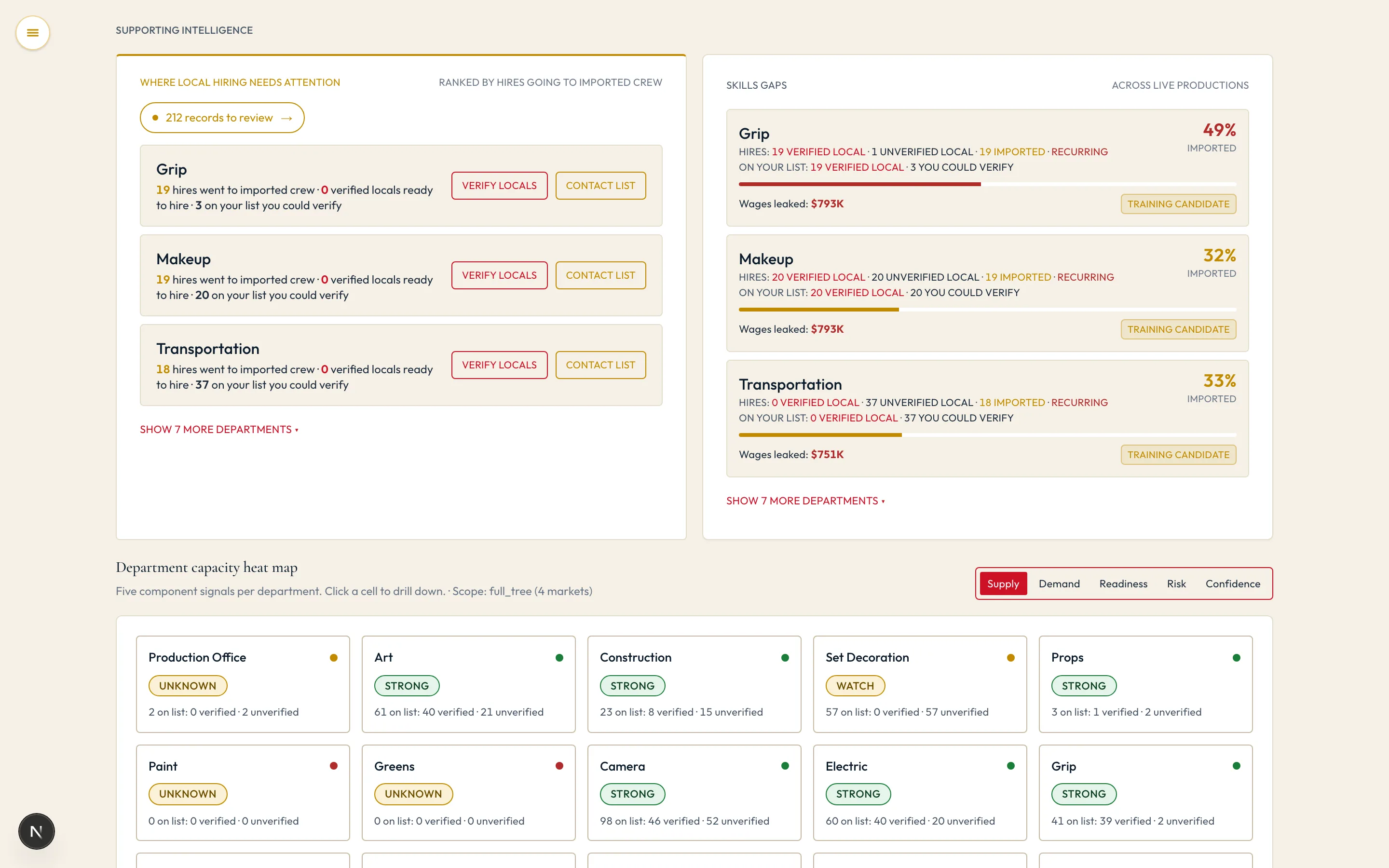
Where hires went to imported crew, department by department — with the wages that left and the locals who could be verified to close the gap. Skills-gap intelligence a commission can act on, not a chart it can only present.

Supporting intelligence on the Georgia demo dashboard: departments ranked by hires going to imported crew, skills gaps for Grip, Makeup, and Transportation with wages leaked per department and training-candidate flags.
Plate 05 — Skills-gap intelligenceGeorgia demo market · seeded data
06

The payoff survives the audit.

The Local Hire Rate (LHR) tracks local hires, wages retained, and movement across active productions — generated, not assembled. Written for committees, budget hearings, and governor’s-office briefings.

A crew member seated in a director’s chair on a quiet stage at the end of a training day.
At wrapStudio Institute Global
+

And it scales with the market.

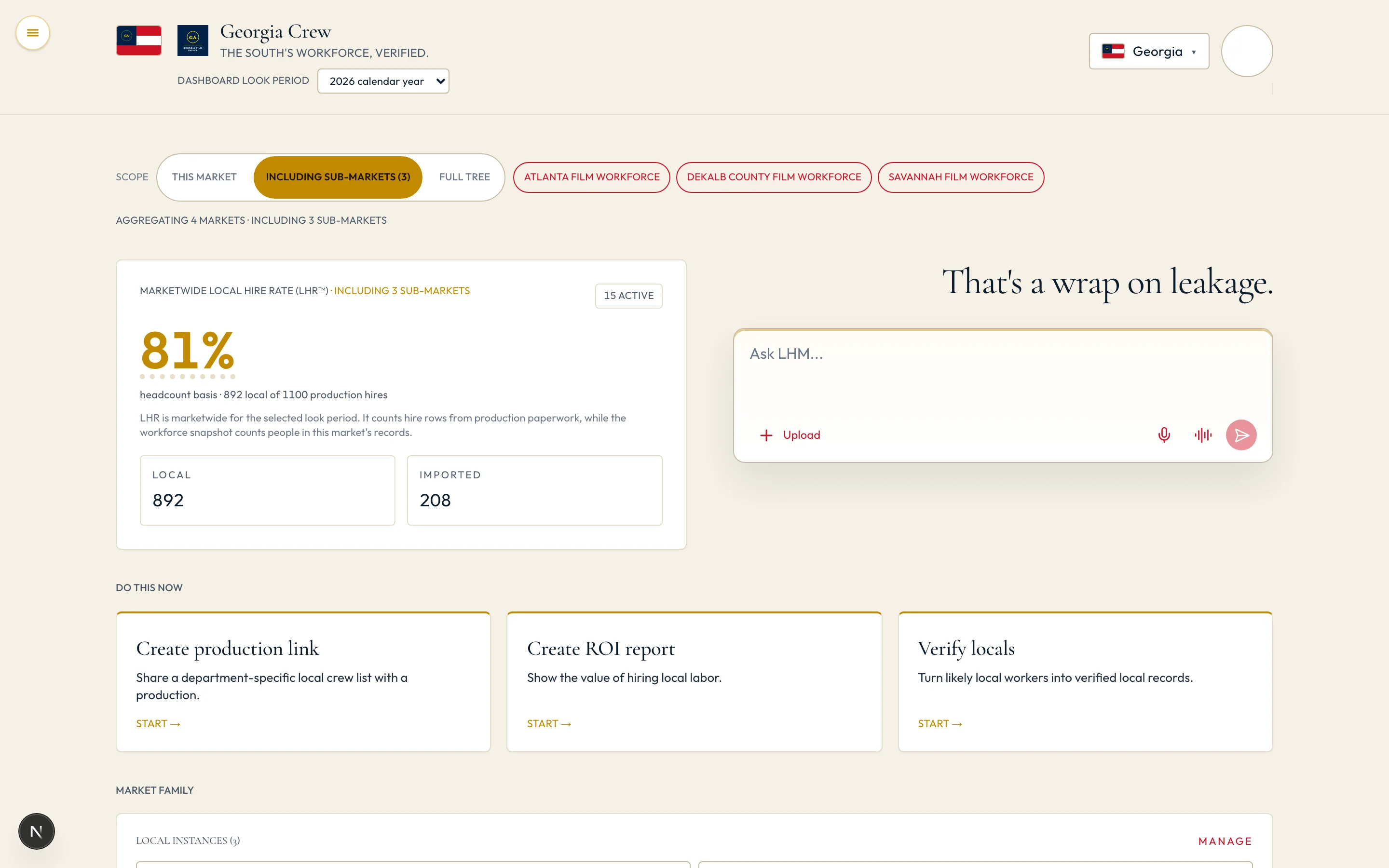
Sub-markets roll up on demand — a state and its cities, an island and its regions. One toggle aggregates four markets into one 81% LHR without losing any market’s own number.

The Georgia demo dashboard with the scope toggle set to include three sub-markets — Atlanta, DeKalb County, and Savannah — aggregating four markets to an 81% Local Hire Rate.
Plate 07 — Sub-market roll-upGeorgia demo market · seeded data

The asset stays with the market

Every production leaves the workforce picture better than it found it.

A rented report expires. LHM leaves the market with a governed workforce asset that becomes more complete as productions hire, crew members claim records, commissions verify status, and training providers respond to demonstrated gaps.

The market that starts today is more informed after the next production—and materially smarter a year from now.

ProductionsContribute current hiring activity and engagement evidence.
CrewClaim, control, and keep their records current.
CommissionsGovern local status, access, and market reporting.
Training providersSee real department demand and connect placements to work.
One governed workforce asset · owned and improved by the market

Who it’s for

One platform. Every seat at the table.

Commission

Prove the incentive works.

A commission-branded portal over the whole market: verified rosters, department capacity, skills gaps with wages attached, and reporting that holds up in front of the legislature.

Production · UPM

Staff local, without the paperwork war.

See what a market can actually deliver, department by department, before the trucks roll — no more landing and discovering the gaps. Local crew lists shared straight to the production. Savings estimated at greenlight, reconciled at wrap — avoided travel, housing, and per diem, quantified per hire.

Studio

A studio-branded instance for every tenant production.

The same verified manifest, carrying the studio’s own brand — local capacity visible before a production ever lands on the lot.

Schools · Training programs

Prove graduates get hired.

Connect program completion to real production engagement, see department demand before planning the next cohort, and give the market a measurable path from training investment to the call sheet.

Individual crew

Own your record. Get found. Stay hired.

Claim the record productions already created for you, verify residency once, and appear in the rosters commissions hand to incoming productions — credits current, IMDb linked, on your terms, with your consent.

“One governed system. Every view of one hire—from the worker and production to the film office, training partner, and legislature.”

Trust, by design

Workforce data is personal. The discipline is the product.

Consent-first.

Records are private until their owners claim them. Contact details render only when the crew member has opted in to share — and only through an active manifest link.

From the product: “Direct contact not shared.”

AI-assisted. Human-governed.

The workflow organizes production activity, reconciles records, guides profile completion, and helps commissioners navigate market operations. AI never decides identity, residency, or local status on its own.

Every consequential change stays behind consent, validation, and confirmation.

“Local” means Verified.

In LHM, “local” is reserved for residency-Verified records. Everything else says exactly what it is — self-claimed, production-attested, unverified — in the interface and in every report.

One word, one meaning, every market.

Market-governed.

The market defines its local-status rules, controls operational access, and keeps a traceable workforce record instead of surrendering the workforce question to a generic directory.

The policy stays local. The evidence stays reconstructable.

The Founding Market path

See it privately. Activate it deliberately. Make it real.

Authorized markets begin with a private, market-branded demonstration workspace using representative data. Selected Founding Markets then replace the demonstration with governed local data and operating workflows. A market is called live only when the real system is working.

01

Registered

Private demonstration

A market-named LHM workspace with representative data gives the commissioner something concrete to show internal leaders, workforce partners, schools, studios, and prospective funders.

No real workforce records, verification claims, or live-market status.

02

Activated

Governed setup

The market enters the Founding Market program. LHM configures governance, establishes the administrator, ingests an authorized seed source, and prepares claim and production-intake workflows.

Representative data gives way to authorized market data.

03

Live

Operating market

Crew claim and control records, local status is governed, production activity is reconciled, and the market can produce defensible workforce intelligence from real activity.

A market goes Live when operating readiness is achieved.

Request a Founding Market briefing

The demonstration is a coalition-building tool: a shared way to align the commission, economic development, workforce agencies, schools, studios, and funders around one market asset.

More than software

A working system, surrounded by workforce practice.

We establish the first governed baseline.

KSe helps the market map source partners, organize authorized inputs, establish record provenance, and set the operating rules that a generic software subscription leaves behind.

We stay beside the workflow.

From initial setup through ongoing operation, KSe provides wraparound support so market teams can focus on governance, relationships, and workforce decisions—not maintaining another database.

We connect intelligence to training.

Department gaps do not die in a report. They become a practical signal for schools, academies, unions, and workforce partners deciding what to build next.

The market keeps what the work creates.

Every claim, credit, engagement, and placement improves a market-owned workforce record that remains useful long after any one production wraps.

Why Kalison Studios

Two decades building crews taught us where local hire breaks. Now we measure and solve it.

We didn’t come to local hire from the outside. Kalison built the industry’s training from the inside — and lived the gaps that import whole departments and leak local wages. The Local Hire Rate measures them; LHM closes them.

1stAccredited U.S. college on a working studio lot
20+Years building the industry’s crews
77Markets measured by the Local Hire Rate
$2.5BIn local crew wages to recapture

Our origin is training.

Founding President of Relativity Media’s education division; studio-based academies and union-backed crew pipelines across nine markets — all inside real productions, including the first accredited U.S. college on a working studio lot, recognized by Variety, The Wrap, and The Hollywood Reporter.

We lived it firsthand.

Market after market, the same pattern: departments flown in, local wages leaking out, no shared way to measure any of it. That firsthand view is exactly why the Local Hire Rate exists.

Now we measure it.

The LHR is the first standardized measure of how production spending becomes local jobs — 77 markets across 31 U.S. states and 46 countries. The Hollywood Reporter featured it, putting Georgia at 72%, with millions in crew wages still to capture.

And we solve it.

LHM turns measurement into action — ongoing evidence, guidance, and defensible wrap reports that help training partners, productions, and film offices make local hire a verified, fundable record.

LHM did not come from a generic software company looking for an industry. It came from two decades spent building training institutions, crew pipelines, and studio-based academies inside the production economy.

That operating history is why LHM connects the whole chain—from the worker and the call sheet to the commission, the training provider, and the public leader accountable for the incentive.

“Locations tell a production where it can film. LHM tells a market whether its people got the work.”
Inside a working soundstage: set builds, rigging, and ladders under stage light at Studio Institute Global.
From the lotStudio Institute Global
Measure the incentive by the locals it hired.

Request a demo

See your market, made visible.